Should You Be Advertising on Pinterest?
27 February 2026

Luzelle Botha
SEO Specialist
...
Tags
When retailers review their paid media mix, the same platforms usually dominate the conversation: Google, Meta, maybe some short-form video like TikTok or YouTube.
Pinterest rarely makes the cut.
It’s treated as secondary. Experimental. Optional. And honestly, a lot of people don’t even know Pinterest offers paid ads (don’t worry if that’s you).
But that framing misses something important: Pinterest isn’t just another paid social channel. It’s a visual search engine that sits upstream in the discovery journey, influencing purchase decisions long before someone types a question into Google.
By the time a customer searches, they often already have a sense of what they want. And that preference usually didn’t start on a search results page.
Pinterest Isn’t Really “Social Media”
Pinterest behaves differently from most paid social platforms, mainly because it isn’t really social in the way we think about it.
People don’t open it to catch up on friends. They open it to:
- Plan
- Research
- Compare
- Curate
- Visualise what they might buy next
It’s less “What’s happening right now?” and more “What could this look like in my life?”
And that difference matters. When someone is planning, they’re closer to making a decision. They’re building intent.
Pinterest sits between inspiration and search, capturing category interest before branded demand even enters the picture. For visually driven retailers, home, fashion, beauty, wellness, gifting, lifestyle, that early influence shapes taste and narrows options.
Search Doesn’t Just Happen on Google Anymore
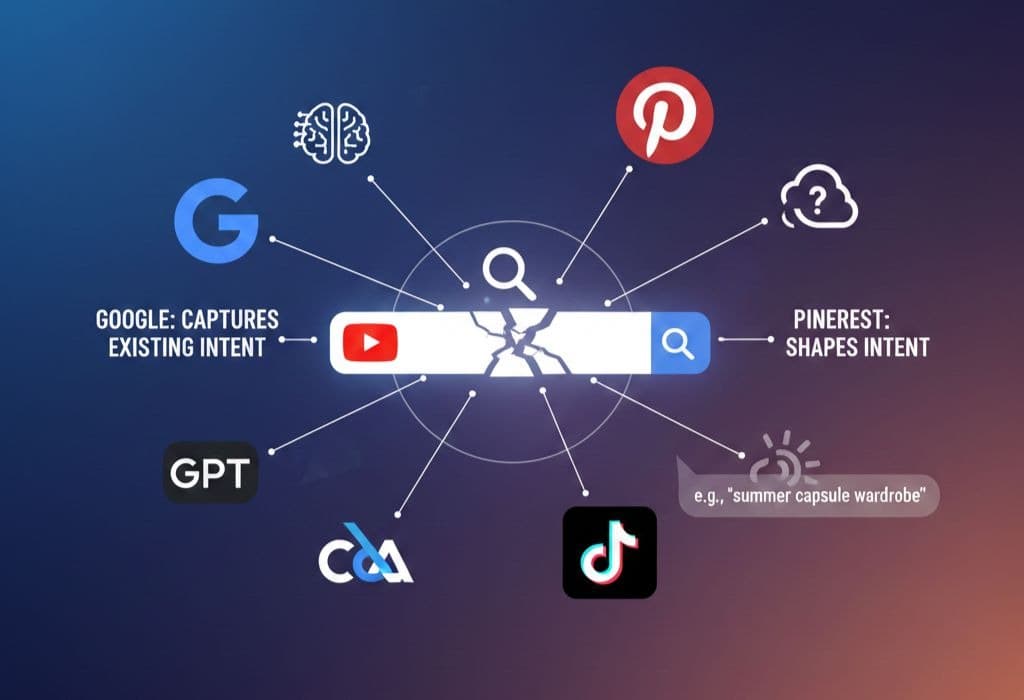
Search no longer starts and ends in a single search bar.
People look for ideas and products everywhere:
- YouTube
- TikTok
- Even tools like GPT, Claude and Perplexity
Search behaviour hasn’t disappeared. It’s fragmented.
Google captures intent that already exists. Pinterest helps shape it.
On Pinterest, users search for things like “summer capsule wardrobe” or “outdoor kitchen ideas.” They’re not looking for a specific brand. They’re exploring possibilities.
If you’re only investing in channels that capture existing demand, you’re entering the conversation after your customer has already made half the decision.
And at that point, you’re competing on preference, not just price.
Pinterest and SEO: More Connected Than You Think
One of the most overlooked things about Pinterest is how closely it mirrors a search engine.
Because it is one.
Users search using keywords. They browse categories. They follow themes. Boards and pins surface based on relevance - just like Google.
Well-optimised pins can rank within Pinterest for category and inspiration-led queries. And they often appear in Google Image results too.
That creates additional entry points into your brand beyond your own website.
For retailers with large product ranges, that can mean:
- More visibility for high-margin collections
- Stronger reinforcement during seasonal campaigns
- Additional exposure for non-branded category terms
- More real estate on the results page
It’s not a replacement for SEO. It reinforces it.
Where It Gets Commercially Interesting
When Pinterest drives early discovery, it often shows up later as:
- Increased branded search
- Higher direct traffic
- Stronger paid search conversion rates
- More returning customers
If someone discovers your brand while browsing “spring outfit ideas,” then searches your name a week later and converts through Google, Pinterest won’t get the credit.
If you only look at last-click attribution, you’ll miss that connection.
In practice, retailers who align Pinterest with seasonal pushes and category clusters often see stronger blended performance - particularly in branded search and returning visitor growth.

The Visual Demand Loop
To understand where Pinterest fits, you need to zoom out.
Retail growth doesn’t move in a straight line. It moves in a loop. We call it the Visual Demand Loop: Inspiration → Preference → Search → Conversion → Repeat
It usually starts with inspiration. A customer isn’t actively shopping yet. They’re browsing ideas - outfits, living rooms, outdoor spaces. They’re imagining possibilities and shaping their taste. This is where Pinterest plays a significant role.
As they explore, preference begins to form. A certain aesthetic. A price range that feels acceptable. Maybe even a brand that keeps appearing. Decisions start to take shape long before a product page is ever opened.
Only then does search come into play. When they head to Google, they’re not starting from scratch. They’re validating a direction they’ve already chosen. That search might look like the beginning of the journey in your analytics, but it isn’t.
Conversion follows. They compare options, click through, and purchase.
If the experience is strong, the loop doesn’t end there. It resets. The next time they begin planning for a new season, a new room, a new event, the cycle starts again.
Pinterest sits at the front of this loop.
If you’re absent from the inspiration phase, you’re entering the journey later, when expectations and price anchors are already set. And once preference is formed, it’s far more expensive to shift.
The retailers who understand this don’t just optimise for clicks. They optimise for influence.
When Pinterest Actually Makes Sense
Pinterest isn’t a magic growth lever. It works brilliantly in some situations - and quietly underperforms in others.
The key is fit.
If Your Category Is Visual
If customers need to see your product to imagine owning it, Pinterest becomes powerful.
Home. Fashion. Beauty. Fitness. Outdoor. Gifting.
These aren’t purely functional purchases. They’re aesthetic decisions. Pinterest thrives where taste is being shaped.
If Your Customers Plan Ahead
Pinterest users plan wardrobes before the seasons change. Renovations before speaking to contractors. Christmas long before December.
If your revenue is influenced by seasonal spikes or event-driven buying, Pinterest allows you to influence decisions well before conversion.
Early positioning matters.

Featured: Pinterest Predicts 2026
If You Have Strong Creative (Or the Ability to Repurpose It)
Pinterest rewards content that feels inspirational rather than promotional:
- Lifestyle imagery
- Styled collections
- Product-in-context content
Many retailers already produce this for campaigns and socials. Pinterest often isn’t about creating more, it’s about placing it strategically.
If you’re feeling channel fatigue somewhere else
Let’s be honest.
- Rising CPMs.
- Flattening ROAS.
- Increased reliance on automated campaign types you can’t fully see inside - we’re looking at you, Performance Max.
When too much revenue depends on one or two auction-based platforms, that’s not efficiency, it’s exposure. Pinterest can provide incremental reach and reduce pressure on the channels doing all the heavy lifting.
Getting Tactical: What Needs to Be in Place
Strategy sounds great in theory. But if you’re going to test Pinterest properly, you need the right foundations.
Not complicated. Just solid.
Start With the Right Formats
You don’t need to reinvent your creatives. You just need to match the format to where the customer is in their journey.
Standard and Video Pins
These are ideal for the inspiration phase.
Think styling ideas, before-and-after transformations, and product-in-context demonstrations. Video, in particular, works well when it shows how something looks, moves or fits into real life.
This is where you influence taste.
Shopping Ads
These pull directly from your product catalogue. They look native in the feed but include real-time pricing and a direct link to purchase.
This is where browsing turns into buying.
Collection Ads
A hero image or video at the top, with supporting products underneath.
Perfect for showcasing a full look - a living room setup, a complete outfit, a table setting - while still letting customers shop individual items. This format works really well when curation is your strength.
Your Product Feed Is Non-Negotiable
If you’re in ecommerce, catalogue integration isn’t optional. It’s the baseline.
Uploading your product feed turns your inventory into dynamic, shoppable Product Pins. Pricing and availability update automatically. It powers Shopping Ads. It enables retargeting for people who viewed products but didn’t purchase.
Without a connected catalogue, you’re limiting performance from the start.
The goal isn’t to overcomplicate it.
It’s to make sure that when someone moves from “that looks nice” to “I want that,” the path to purchase is seamless. Because inspiration without accessibility doesn’t convert.

Why Pinterest Often Looks Like It’s Not Working (When It Is)
Pinterest is often switched off too early. Not because it isn’t working, but because it’s being measured like paid search.
People don’t always click and buy in the same session. So if you judge it purely on:
- Short attribution windows
- Last-click conversions
- Immediate ROAS
…it will look underwhelming.
But that’s not how customers behave.
What Pinterest often influences instead:
- An increase in branded search
- More direct traffic
- Higher conversion rates on paid search
- More returning visitors
- Bigger baskets over time
In other words, it helps create the demand that other channels capture. Last-click reporting loves tidy stories. Real customer journeys aren’t tidy.
The retailers who get this right ask different questions:
- Is blended acquisition cost improving?
- Are you acquiring more new customers?
- Is branded search growing after campaigns launch?
- Are certain categories seeing an increase during seasonal pushes?
- What happens in geo regions where Pinterest runs versus where it doesn’t?
When you zoom out and look at performance as a system, Pinterest’s contribution often looks very different.
What Good Pinterest Actually Looks Like
When Pinterest works, it looks intentional.
- Boards mirror how you sell.
- Seasonal content goes live early.
- Descriptions reflect how people actually search.
- Product feeds are clean and structured.
- Prospecting and retargeting are clearly separated.
It’s not complicated, but it is connected. Pinterest performs best when it’s aligned with SEO, merchandising calendars, and paid search - not treated as a siloed experiment.
When Pinterest Probably Isn’t a Priority
It may not be the right move if:
- Your category is heavily commoditised and price-led
- Purchases are purely impulse-driven
- You lack strong visual assets
- You can’t measure beyond last-click attribution
- You need immediate short-term spikes
It’s not about if Pinterest “works.” It’s about if it fits your commercial model.
The Cost of Ignoring Visual Search
Turning a blind eye to the different ways search happens today will cost your business exposure, influence and - most importantly - revenue.
If your customers:
- Browse visually before they search
- Plan purchases around seasons or life events
- Compare options before committing
- Respond to curated inspiration
Then Pinterest is already influencing their journey. The question is whether your brand is part of that influence.
Search doesn’t always begin with a keyword. It often begins with an idea - a saved pin, a curated board, a visual reference point.
If you’re reviewing your paid and organic strategy this year, it’s worth asking whether visual search is shaping demand in your category - even if you haven’t invested in it yet.
Because your customers are planning somewhere - make sure they're planning with you.