The Missing Metric in Ecommerce Growth Strategy: Cost Per Fulfilled Order
23 March 2026

Deanna Pillay
Shopify Services Lead
I'm passionate about how technology can transform customer experiences and drive e-commerce growth. I help businesses unlock results through customer-focused, practical digital strategies. With a background across e-commerce, account leadership, digital project management, and strategy, I work at the intersection of thinking and doing — turning ideas into measurable outcomes.
Tags
Everyone wants to scale ecommerce revenue.
More traffic. Higher conversion rates. Bigger campaigns. Better ROAS. Growth is the headline metric in every dashboard and every C-suite update. It’s what gets celebrated. It’s what gets funded.
But there’s another side to the equation most retailers rarely measure: the true cost of fulfilling an order.
The Metric Most Ecommerce Teams Don’t Track
Most ecommerce businesses don’t explicitly measure the cost per fulfilled order.
Not because it isn’t important, but because it sits between teams. Marketing owns growth. Operations own fulfilment. Finance owns margins. Customer service handles the fallout.
But the metric itself often belongs to no one.
At its core, it answers a deceptively simple question: What does it truly cost to get an order from “Buy Now” to signed-for delivery within 48 hours?
Understanding the True Cost of Fulfilment
At first glance, that might sound like a simple calculation. In reality, it rarely is.
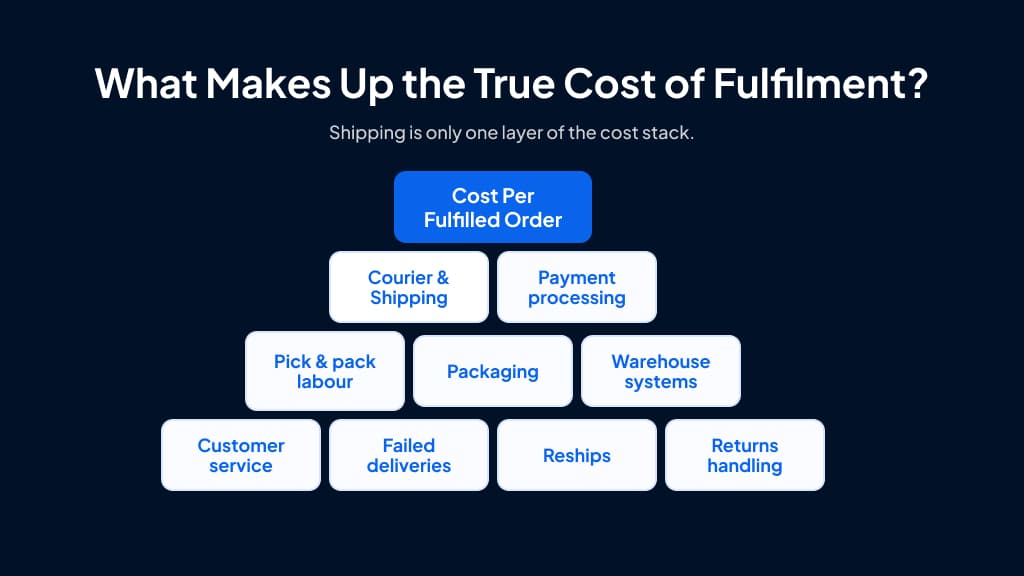
Most retailers default to the most obvious line item: the courier fee. But the true cost of fulfilment is far broader than that, touching almost every operational function inside an ecommerce business.
Packaging materials, pick and pack labour, warehouse systems, payment processing fees, failed deliveries, re-shipments, returns handling, refund processing, customer service time, and the margin impact of speed - all of these things contribute to the real cost of getting an order from confirmation to doorstep.
Individually, these costs often sit, hidden, within different operational budgets. Together, they define the economics of ecommerce fulfilment.
This is why cost per fulfilled order is such a valuable metric. It consolidates the operational reality behind each transaction, giving businesses a clearer view of what growth actually costs once the order leaves the checkout page.
Customers Don’t See the Complexity Behind an Order
Customers, of course, see none of this complexity.
They don’t see the carrier cut-off times that determine whether an order ships today or tomorrow. They don’t see stock transfers between warehouses to fulfil a single order, or the pressure that builds inside fulfilment operations during promotions, seasonal spikes, or viral product moments.
What they see is a confirmation email and an expectation: that their order will move smoothly from checkout to delivery within a predictable timeframe.
Increasingly, that expectation is measured in hours rather than days. What was once considered premium fulfilment is now closer to baseline.
For retailers, meeting that expectation requires systems, processes, and infrastructure working in sync behind the scenes.
Demand Has Become Easier to Scale
At the same time, the demand side of ecommerce has evolved rapidly.
Over the past decade, retailers have become extremely sophisticated at generating and capturing demand. AI-powered personalisation, performance marketing optimisation, social commerce campaigns, and conversion rate experimentation have given ecommerce teams powerful tools to accelerate traffic and sales.
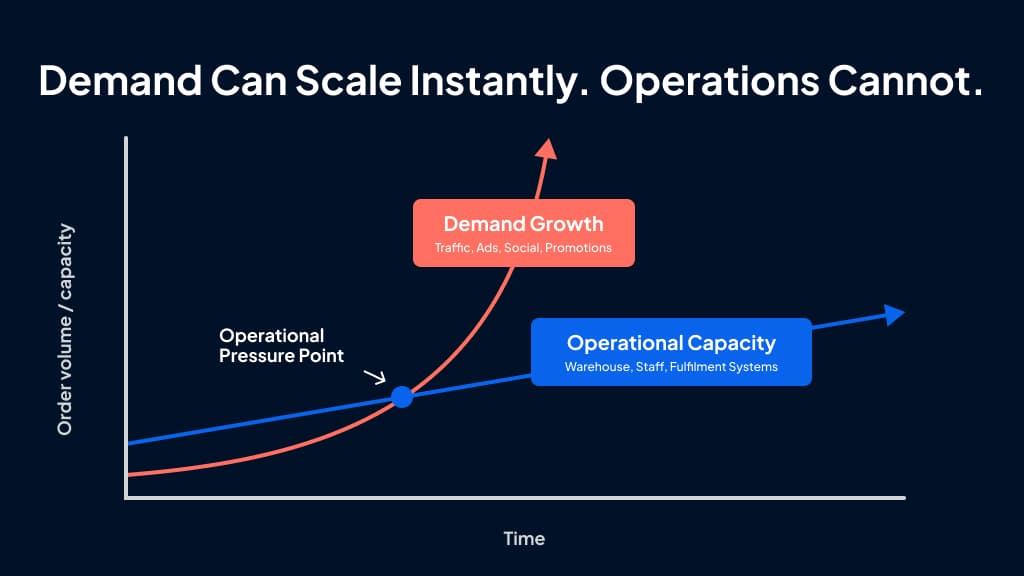
In many cases, demand can scale almost instantly.
Operations, however, rarely scale at the same speed.
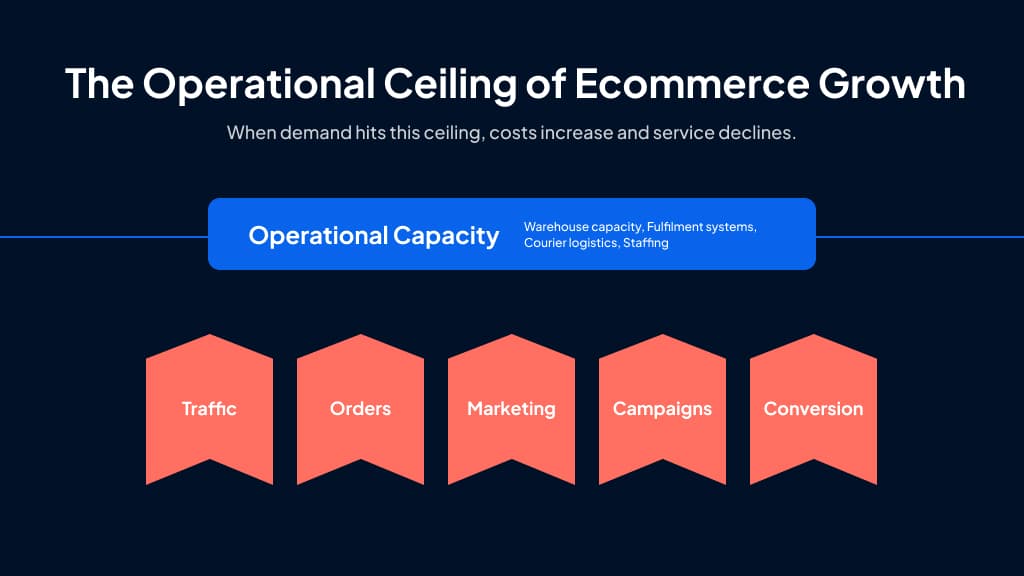
Fulfilment processes depend on physical infrastructure: warehouse space, staffing capacity, courier networks, and inventory systems. These systems can grow, but they tend to do so gradually, and often at significant cost.
This creates a structural tension inside many ecommerce businesses: demand can increase overnight, but operational capacity cannot.
The Operational Ceiling of Ecommerce Growth
Every ecommerce business has a ceiling to its growth. Not a demand ceiling, but an operational one.
This ceiling is defined by how efficiently orders can be processed, packed, shipped, and supported as order volume increases.
When demand grows faster than operational capacity, the effects rarely appear immediately. At first, they show up in subtle ways:
- Fulfilment costs creeping upward
- Delivery windows becoming harder to maintain
- Warehouse pressure during peak periods
- Increased returns or shipping errors
- Greater strain on customer service teams
Over time, those pressures compound.
What initially appears to be successful growth can begin to erode margins or create friction in the customer experience.
Understanding where that operational ceiling sits is one of the most important steps in building sustainable ecommerce growth.
How to Identify Your Operational Pressure Point
A practical starting point is surprisingly simple.
Calculate your fully loaded cost per fulfilled order at your current order volume. Rather than focusing only on shipping fees, include the operational costs that sit behind each order: labour, packaging, payment processing, returns handling, and support time.
Once that number is clear, model what happens if order volume increases by around 20 percent.
An Example of This Cost
Imagine an ecommerce retailer currently processes 1,000 orders per month. Their average costs per order might look something like this:
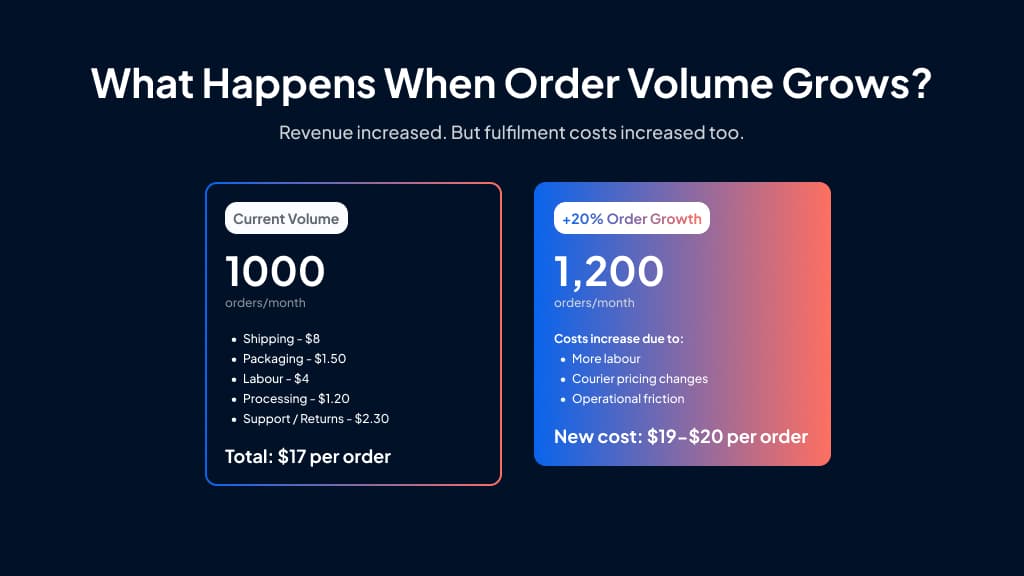
That places their fully loaded fulfilment cost at $17 per order.
Now model what happens if demand grows by 20 percent, increasing monthly orders to 1,200.
At that higher volume, several things might change:
- Additional warehouse staff may be required during peak periods
- Courier pricing tiers may shift
- Returns processing and support workloads increase
- Warehouse inefficiencies start appearing as order density rises
Those adjustments might push fulfilment costs closer to $19 or $20 per order.
The result is subtle but important: revenue has increased, but the cost of fulfilling each order has also risen.
That difference may not appear in top-line growth metrics, but over time it can erode margins or place strain on operations if it isn’t understood early.
Why This Metric Matters for Your Ecommerce Strategy
Very few ecommerce teams measure cost per fulfilled order intentionally.
Growth metrics dominate reporting conversations, while operational economics remain fragmented across departments. Marketing focuses on acquisition, finance tracks margins, operations manage fulfilment, and customer service deals with the downstream impact.
Yet the relationship between demand and fulfilment sits at the centre of sustainable ecommerce growth.
Marketing can generate demand quickly. Paid campaigns can scale, new audiences can be activated, and traffic can increase almost overnight.
Fulfilment capacity, however, is built through systems, infrastructure, and process design. Those elements evolve more gradually.
When demand growth consistently outpaces operational readiness, revenue may increase while margins quietly tighten.
In that sense, growth without operational visibility can become margin erosion in disguise.
Growth Only Works When Operations Can Support It
Understanding cost per fulfilled order changes how ecommerce leaders think about growth.
Instead of asking only how fast demand can increase, it encourages teams to consider how efficiently that demand can be supported operationally.
The most successful ecommerce businesses treat these questions as two sides of the same strategy. Demand generation and operational capability evolve together, ensuring increased order volume strengthens the business rather than placing strain on it.
But gaining that visibility isn’t always straightforward. Sometimes the issue sits in acquisition strategy. Sometimes it’s platform architecture. Sometimes it’s fulfilment infrastructure quietly limiting what the business can scale.
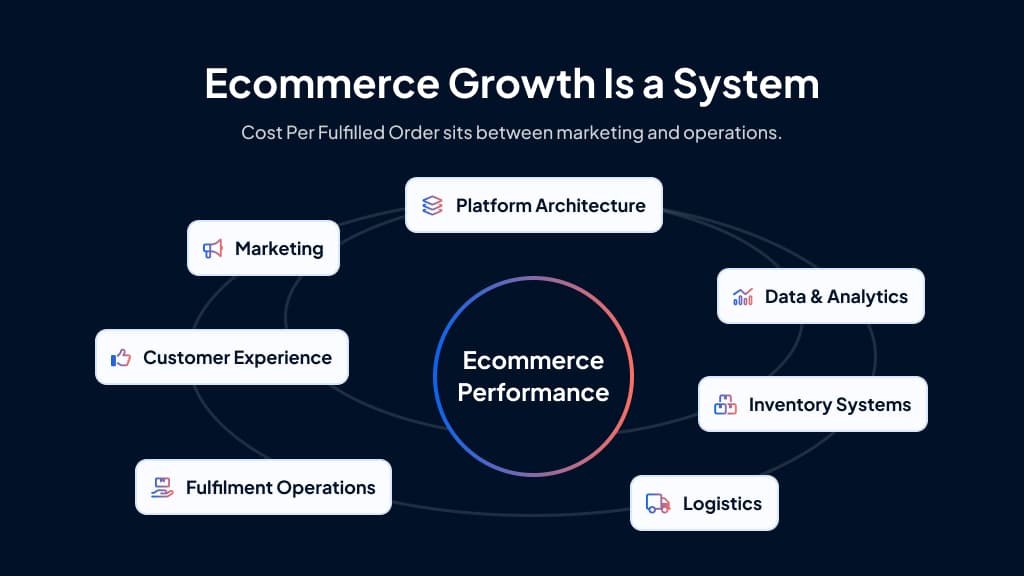
What matters is identifying the constraint before growth begins pushing against it.
That’s where working with an ecommerce partner who understands the entire ecosystem can make the difference. One that looks beyond traffic and campaigns to examine how your platform, operations, marketing systems, and customer experience actually function together.
Because when ecommerce growth stalls, it’s rarely demand that’s missing. More often, it’s visibility into what’s truly holding the business back.