What Is Google's New AI Ranking Model, and Why Should You Care?
30 September 2026

Luzelle Botha
SEO Specialist
...
Tags
Let's get one thing straight before you touch anything on your site: most of what's being called "Google's new ranking algorithm" this month is actually a research paper. It hasn't shipped anywhere, and there's no evidence it's currently affecting Google Search.
It is interesting, though.
Google DeepMind, working with researchers from the University of Massachusetts Amherst and the University of Texas at Austin, has published a new approach to search ranking called Autoregressive Ranking, or ARR. It's essentially a different answer to a problem search engines have wrestled with for years: how do you rank an enormous number of pages accurately without making the process painfully slow?
Search Ranking Has Always Been a Compromise
Here's something most people probably don't think about when they Google something: the search engine can't carefully read every potentially relevant page before deciding where it belongs.
There are simply too many of them.
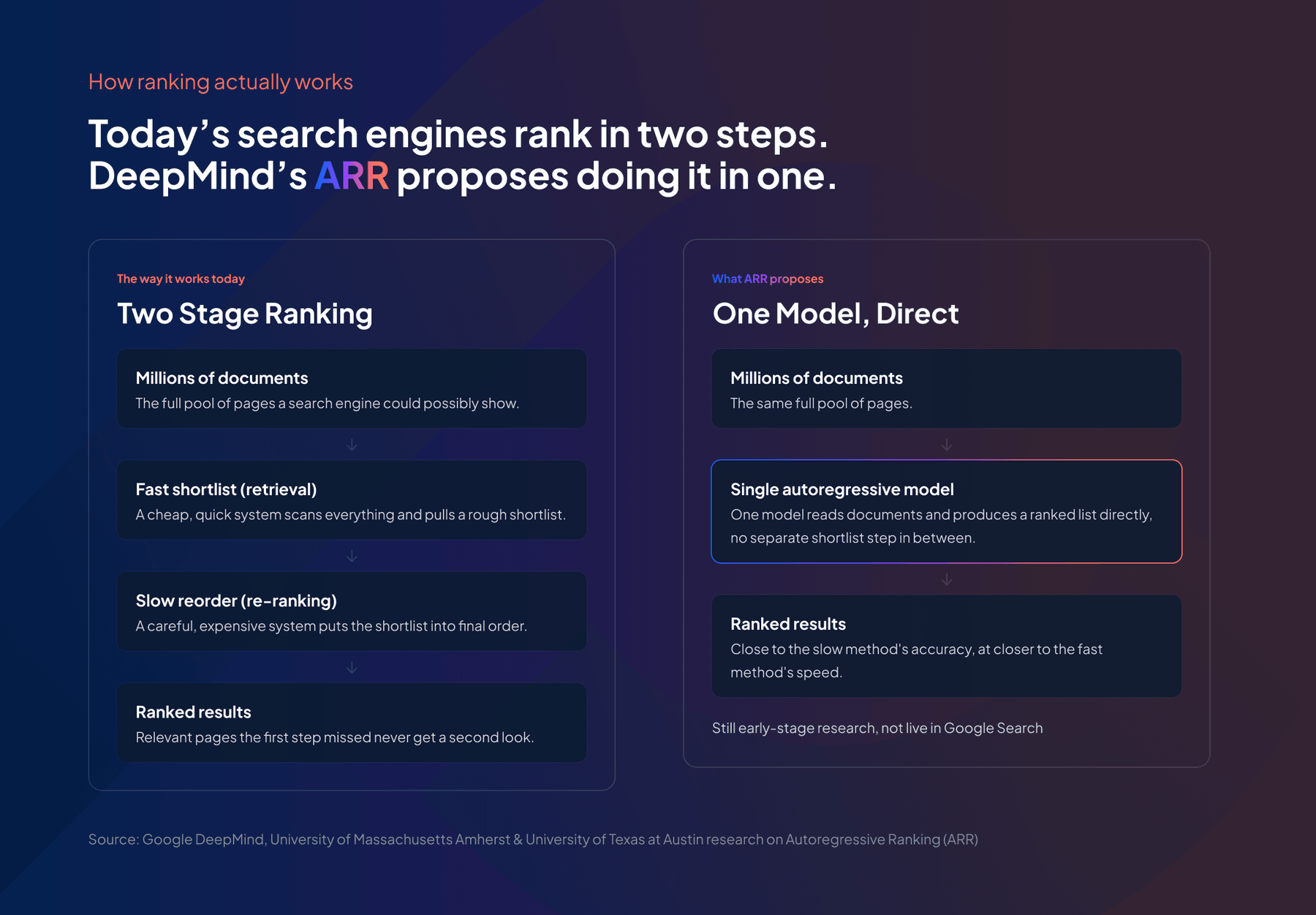
So search engines typically split the job in two. A fast system scans a huge number of documents and creates a shortlist of potentially relevant results. A second, more computationally expensive system then takes a closer look at that smaller group and decides how they should be ranked.
It works, but there's an obvious limitation. If a genuinely relevant page doesn't make it through that first pass, the more sophisticated ranking system never gets the chance to consider it.
What ARR Actually Changes
ARR tries to remove that two-stage process.
Instead of one system creating the shortlist and another reranking it, a single model reads the documents and produces the ranked list directly.
In DeepMind's testing, the model matched or outperformed the more computationally expensive approach on most of the tests, although it fell behind on one measure in a shopping-search test. The interesting part is that it did this while operating closer to the speed you'd expect from the faster first-stage system.
In other words, the researchers are exploring whether you can get more of the accuracy of the slower method without paying the same computational cost.
They also found that the approach could work across a much larger collection of documents without the model itself needing to grow alongside it. If you're thinking about search at internet scale, that's an important part of the research.
Is Any of This Live in Google Search?
No. This is still research, not something running in Google Search.
The work has been tested on academic datasets, and there's no indication that it's being used in live search results or that Google plans to roll it out anytime soon. DeepMind publishes research regularly, and plenty of those ideas never become consumer-facing products at all.
So, interesting research? Absolutely. A reason to rethink your SEO strategy or explain a rankings change? Not at this stage.
So Why Does It Matter?
Mostly because it's useful context for where search research is going.
ARR is exploring how ranking systems could understand relevance more effectively without the same computational trade-offs. At the same time, the Google Search we're actually using is becoming more AI-driven through products like AI Overviews and AI Mode.
I wouldn't draw a straight technical line between those products and ARR. This paper doesn't tell us that ARR is powering them or that Google plans to use it for them.
What it does show is the kind of problem Google's researchers are working on: understanding relevance and meaning at scale, rather than relying solely on simpler matching systems to narrow the field first.
That's worth knowing about. It just isn't something you need to react to yet.
What Would Matter for SEO If This Direction Continues?
This is where I'd be careful not to overcomplicate things.
Nothing in the research suggests you suddenly need a new "ARR SEO strategy". In fact, the practical implications look pretty familiar.
Focus on:
- Answering the actual question clearly. Don't make someone dig through three paragraphs of setup before you get to the information they came for.
- Giving content a credible source. Use real authors, relevant expertise and first-hand knowledge where you have it.
- Structuring information clearly. Make the main answer and the reasoning behind it easy for both people and machines to understand.
None of that depends on ARR eventually making its way into Google Search.
And if ranking systems continue getting better at understanding meaning and relevance, stuffing a page with slightly different versions of the same keyword isn't suddenly going to become a better strategy.
It wasn't particularly useful to the person reading the page anyway.
What To Actually Do About It
For now? Probably nothing specifically because of ARR.
I wouldn't rewrite pages, change your keyword strategy or start adding "AI optimisation" tactics because Google DeepMind published a research paper.
Keep doing the less exciting things that actually matter: answer search intent properly, make your content genuinely useful, keep your technical foundations healthy and pay attention to how your organic visibility is changing.
If ARR, or something influenced by this research, eventually makes its way into Google Search, that's the point where we'll have real-world behaviour to analyse. Until then, it's useful research to understand, not an algorithm update to chase.
Want to talk through what any of this means for your specific site? Reach out to our team. We're always happy to nerd out about this stuff with you.