New Customers vs Returning Customers: Why Your Ecommerce Store Needs Two Playbooks, Not One
25 August 2026
Deanna Pillay
Shopify Services Lead
I'm passionate about how technology can transform customer experiences and drive e-commerce growth. I help businesses unlock results through customer-focused, practical digital strategies. With a background across e-commerce, account leadership, digital project management, and strategy, I work at the intersection of thinking and doing — turning ideas into measurable outcomes.
Tags
Most ecommerce stores talk to every customer the same way. One welcome flow. One set of ads. One tone of voice, no matter who's reading.
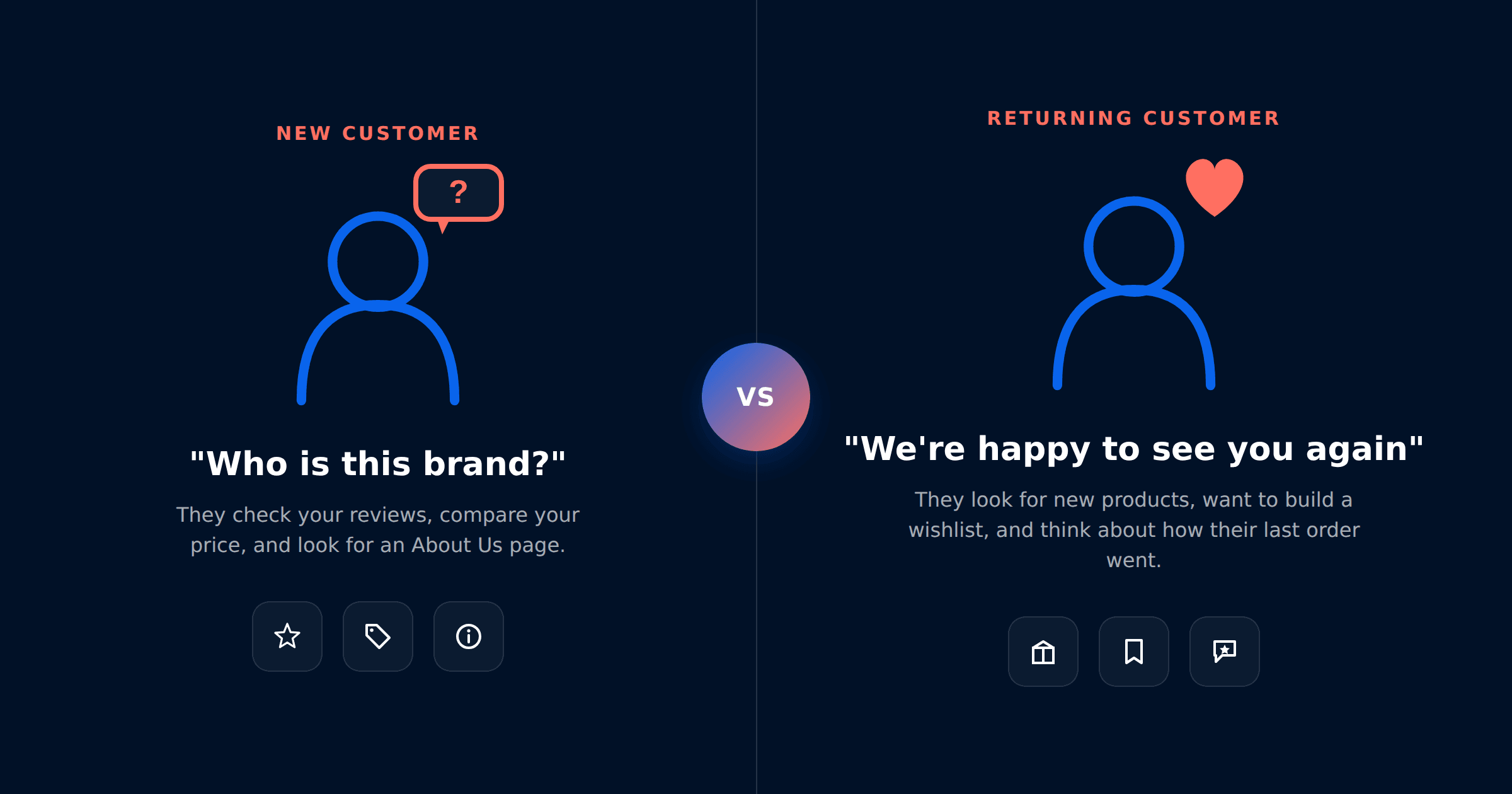
The problem is a first-time visitor and a five-time buyer are having completely different conversations with your brand. One is asking "can I trust you?" The other is asking "why should I bother again?" If you answer both questions with the same message, you'll do a mediocre job at both.
Here's how to think about the two lifecycles separately, and what to actually do about it.
Two customers, two very different journeys
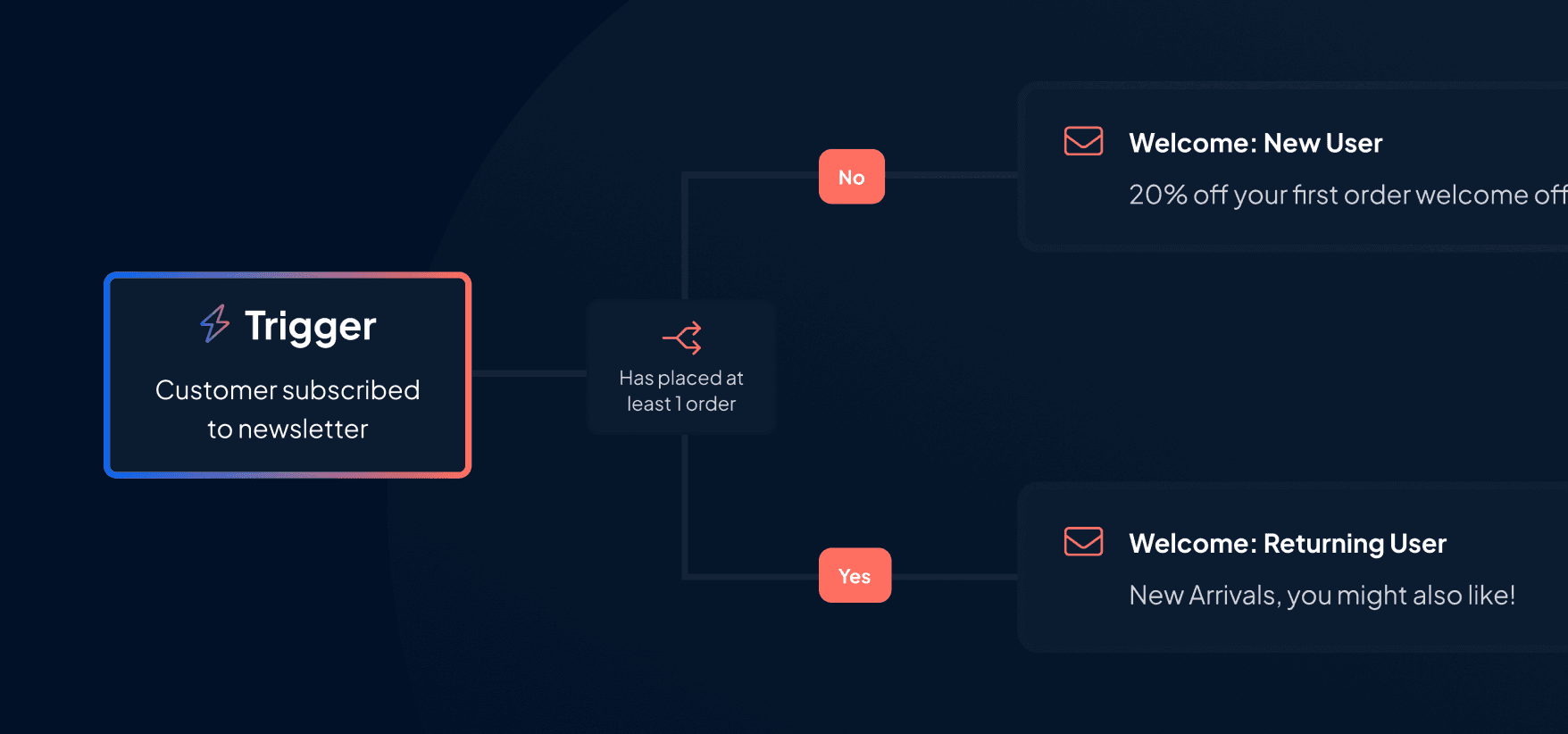
A new customer doesn't know you. They found you through an ad, a search, or a friend's recommendation. They're comparing you to competitors, checking your reviews, and deciding if your price feels fair. Their questions are basic: Is this a real business? Will my order arrive? What happens if I don't like it?
A returning customer has already answered those questions. They know your shipping times. They know your sizing runs small, or your skincare works, or your coffee ships fresh. Their questions have moved on: Is there something new? Am I still getting a good deal? Do they remember me?
Treating both groups the same means you're either overwhelming new customers with loyalty talk they haven't earned yet, or boring your best customers with basic trust-building they don't need anymore.
The new customer journey: earn the first yes
A first-time buyer moves through a short but fragile path. Every step is a chance to lose them.
- Discovery. They land on your site from an ad, search, or social post. First impressions happen in seconds, mostly on page speed and how clear your offer is.
- Evaluation. They check reviews, shipping costs, and return policy before anything else. This is where trust is won or lost.
- First purchase. They commit, but they're still nervous. A confirmation email that feels human, not automated, matters more here than any other point in the relationship.
- First experience. The unboxing, the product itself, how fast it arrived. This decides whether there's a second purchase at all.
The new trust question: "did a bot build this, and am I about to get scammed?"
The trust bar has moved. It's no longer just "is this a real business." Shoppers have seen enough AI-generated storefronts, fake reviews, and stock-photo product pages to ask a sharper question: does a real business run this, or did someone spin up a store overnight to take my money and disappear?
That suspicion shows up in small, specific ways:
- Product photos that look slightly off, too perfect, or clearly AI-generated rather than real shots of the real product.
- Copy that reads generic or oddly repetitive, like it was written in bulk rather than by someone who actually knows the product.
- No real address, phone number, or named team anywhere on the site.
- Reviews that all sound the same, or arrived in one suspicious batch.
- Social accounts that are brand new, have no comments, or don't match the size of the store.
None of this means "don't use AI." It means the fixes for AI-era trust are the same fixes that build trust in general, just more urgent. A shopper who's been burned once by a fake store now checks harder before buying from a new one, and every brand pays the price of that suspicion whether they earned it or not.
Ways to close that gap fast:
- Show real people. A founder photo, a small team page, or a face in your emails beats any trust badge.
- Use real product photography, not stock images or obviously generated ones.
- Put a real contact method somewhere visible. A phone number or physical address does more for trust than a chat bot ever will.
- Let reviews build up naturally and show the messy, mixed ones too. All five-star, all recent, all similar-sounding reviews read as fake even when they're not.
- Be specific about your business. Where you're based, how long you've been trading, what makes your supply chain real. A vague "about us" page used to be filler. Now it reads as a red flag.
How to talk to a new customer
Speak like you're meeting someone for the first time, because you are.
- Lead with clarity, not cleverness. Say what the product does and what it costs.
- Show proof. Reviews, ratings, and real customer photos do more work than any headline.
- Keep your tone warm but not overly familiar. They haven't earned "hey friend" energy yet.
- Set expectations honestly on shipping and returns. Surprises lose trust fast.
- Make the first email about the order, not about upselling. Confirm, reassure, and be quick about it.
The returning customer journey: keep giving them reasons
Once someone buys, the goal changes from "convince them" to "stay useful to them."
- Post-purchase. The gap between delivery and their next thought about your brand. This is where most stores go quiet, and where most repeat purchases are lost.
- Re-engagement. A reminder that you exist, ideally tied to something relevant, like a restock, a new season, or a milestone since their last order.
- Repeat purchase. They come back because something reminded them, or because they ran out of the product and already trust you to reorder from.
- Loyalty. After a few purchases, they start to see themselves as "a customer of yours," not just someone who bought once.
How to talk to a returning customer
Speak like you know them, because your data says you do.
- Reference their past purchase. "Time to restock your [product]" beats a generic newsletter every time.
- Reward the relationship, not just the transaction. A returning customer notices when a brand never acknowledges they've bought before.
- Tell them what's new, but tie it to what they already like.
- Ask for feedback. A returning customer who feels heard is more likely to stay.
- Don't oversell. They already said yes once. Respect that.

How do you win back the customers who left?
Every store has a group of customers who bought once, maybe twice, and then quietly stopped opening emails. Winning them back is cheaper than finding new customers, but it needs a different message than either of the two journeys above.
- Find them first. Segment by last purchase date. Someone who hasn't bought in 90 days behaves differently to someone who hasn't bought in a year.
- Acknowledge the gap, gently. "We haven't seen you in a while" works better than pretending nothing happened.
- Lead with what's changed. New products, better shipping, a fixed problem. Give them a real reason to look again, not just a discount.
- Use the discount as a last resort, not a first move. If every win-back email is 20% off, customers learn to wait for it, which trains them to leave on purpose.
- Make it easy to say no. A clear unsubscribe option builds more trust than you'd expect. It's better than someone marking you as spam.
Does your customer know your USP? Do you?
This is the question most ecommerce brands skip. A "unique selling point" (USP), the one clear reason to choose you over anyone else, only works if the customer actually knows it. Plenty of brands have a genuine USP buried in an About page nobody reads.
Ask yourself honestly:
- If a customer had to explain in one sentence why they buy from you and not a competitor, could they?
- Is your USP on your homepage, in your ads, and in your emails, or just somewhere in the footer?
- Does your USP show up differently for a new customer (why trust us) versus a returning one (why stay with us)?
A strong USP does double duty. For new customers, it answers "why you, not them." For returning customers, it answers "why stay, not switch." If your USP only works for one of those questions, it's incomplete.
The real problems worth solving for retention
Most retention problems aren't solved with another discount code. They're solved by fixing the actual reasons customers don't come back.
- Slow or unclear post-purchase communication. If a customer doesn't know where their order is, they won't trust you with a second one.
- No memory of the customer. Sending the same generic email to someone on their first visit and their tenth purchase tells them you're not paying attention.
- Discount dependency. If customers only return when there's a sale, you've trained them to wait, not to trust the brand itself.
- A weak or invisible USP. If customers can't say why they chose you, they won't have a reason to choose you again next time.
- No plan for the quiet period. The weeks between purchases are where most brands go silent, and where most customers forget you exist.
The short version
New customers need proof. Returning customers need to feel remembered. Lapsed customers need a real reason, not just a discount. And none of it works if your customers can't tell you, in their own words, why they buy from you.
If you're not sure where your store is losing people along this journey, that's usually the first thing worth looking at, before spending more on ads to bring new customers into the same leaky funnel.