A quiet platform update just sped up most Shopify stores
14 October 2026

Deanna Pillay
Shopify Services Lead
I'm passionate about how technology can transform customer experiences and drive e-commerce growth. I help businesses unlock results through customer-focused, practical digital strategies. With a background across e-commerce, account leadership, digital project management, and strategy, I work at the intersection of thinking and doing — turning ideas into measurable outcomes.
Tags
A few hundred milliseconds of page load time is the difference between a sale and a bounce. Shopify's own research ties every extra second of load time to a measurable drop in conversion, so when the platform itself gets meaningfully faster, every store built on it benefits without lifting a finger.
That's exactly what happened in September. Shopify quietly shipped a change to how Liquid storefronts render, and the result is a real jump in loading speed, Dawn, Horizon and every theme built on the modern template system included.
What actually changed
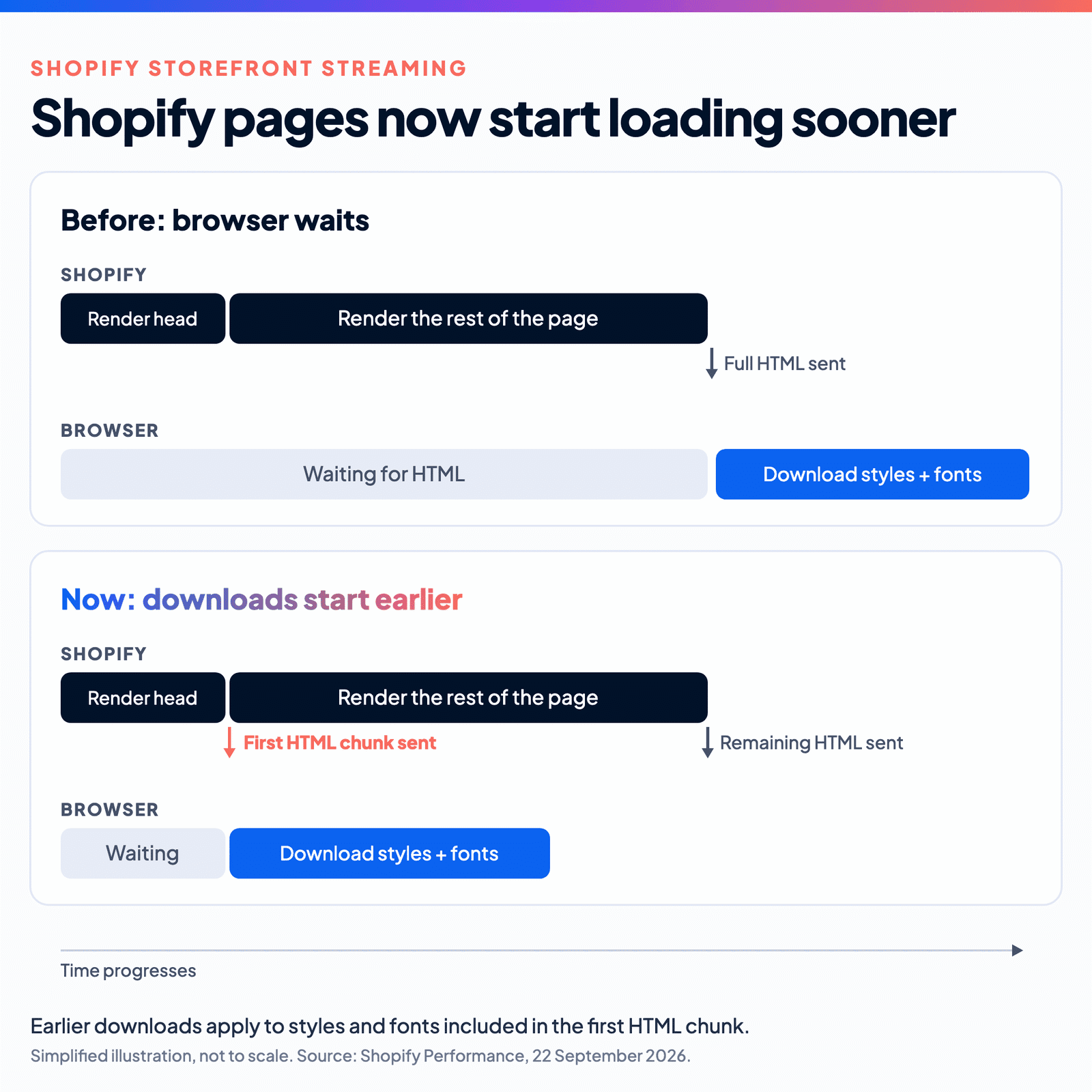
The short version: Shopify now streams the HTML for Liquid storefronts instead of making the browser wait for the whole page to finish rendering before it sees anything.
Previously, a page had to finish rendering completely on Shopify's servers, every section, top to bottom, before any of it was sent to the shopper's browser. Now Shopify sends the top part of the page across as soon as it's ready, instead of making the browser wait for the whole thing to be built first.
That matters because the browser can start downloading stylesheets and fonts the moment it gets that early chunk, in parallel with the server finishing the page, instead of sitting idle waiting for the full response. It's a classic case of doing two things at once instead of one after another, and it adds up to a genuinely faster storefront with no extra work from merchants or developers.
The numbers
Across the median eligible store, Time to First Byte (TTFB) dropped by roughly 29% at p75 and 21% at p90, with First Contentful Paint (FCP) and Largest Contentful Paint (LCP) both improving 2 to 6%. The gains vary by theme:
| Theme | TTFB improvement | FCP improvement |
|---|---|---|
| Dawn | 25% | 3% |
| Horizon | 29% | 8% |
TTFB is the metric that moves most, which makes sense given the change is entirely about how fast the server starts sending content. FCP and LCP move less because they're also shaped by everything downstream, images, apps, third-party scripts, that this change doesn't touch.
Do you need to do anything?
No, and that's the point. The improvement rolled out automatically to eligible stores with no theme changes or merchant action required. There are a couple of conditions behind the scenes though:
- It applies to Shopify's newer theme templates, not the older-style ones some long-running stores still use.
- The theme’s layout needs to output Shopify’s standard content_for_header tag plainly in the head for the speedup to apply.
- It doesn't apply while you're previewing a theme or working in the theme editor, only on the live site.
Most modern Shopify themes, including Dawn and Horizon, already qualify. If your theme has been heavily customised, it's worth asking your developer, or us, to confirm it still does.
Shoppers don't wait
Attention spans online are short, and shoppers expect pages to appear almost instantly. They've been trained by the fastest sites they use every day, so a slow store doesn't just feel slow, it feels broken. Most people won't sit and wait for it to catch up. They'll hit back and buy somewhere else.
The research backs this up. Google found that 53% of mobile visits are abandoned if a page takes longer than three seconds to load. And in Deloitte's Milliseconds Make Millions study, a 0.1 second improvement in mobile site speed lifted retail conversions by 8.4% and average order value by 9.2%.
Speed also shapes whether people come back. A shopper who has a quick, smooth first visit is far more likely to return, open your emails and click through again. A slow first impression makes every later touchpoint work harder. So a faster store doesn't just win the first sale, it supports repeat purchases too.
Why it's worth paying attention to
TTFB feeds directly into LCP, one of Google’s Core Web Vitals, and Core Web Vitals still factor into how a page ranks and how it’s judged on mobile usability. A faster server response gives every other optimisation on a page more breathing room, since there's less time to claw back elsewhere in the loading sequence.
For New Zealand ecommerce stores in particular, where a meaningful share of traffic comes from mobile connections and from shoppers further from Shopify's servers than in the US, shaving time off the very first response matters more, not less. A free, automatic improvement to TTFB is the kind of baseline speed gain that's hard to get any other way without infrastructure work.
The takeaway
This is a reminder that platform-level performance work can move the needle just as much as anything a store does on its own theme or app stack, and it's worth checking in on the fundamentals every so often rather than assuming last year's audit still holds.
If you want to know whether your store is actually eligible for this speedup, or where your Core Web Vitals sit right now, that's exactly the kind of thing we check in a technical SEO audit, get in touch and we'll take a look.