How AI Mode Is Disrupting Your Traffic Flow
26 October 2026

Luzelle Botha
SEO Specialist
...
Tags
Your traffic hasn't dropped because you did something wrong. It's dropped because Google changed the game, and most businesses haven't realised it yet.
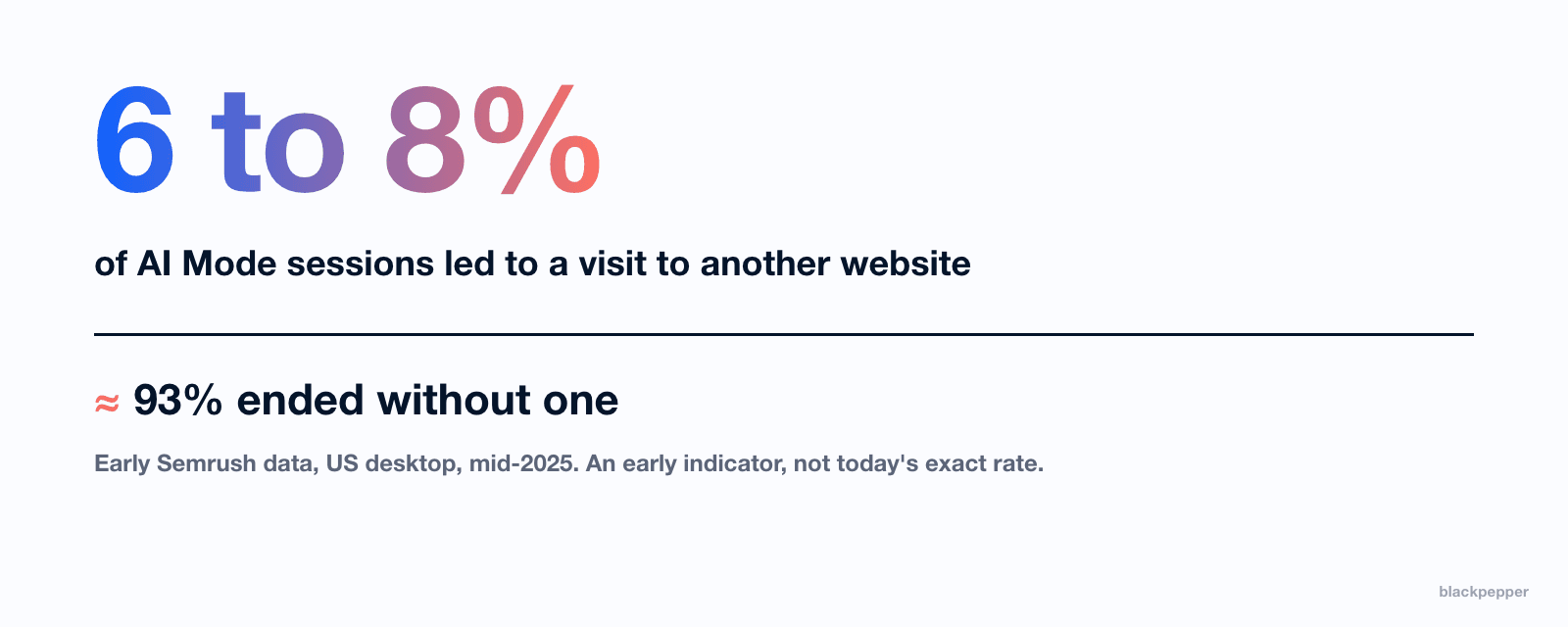
Quick answer: If your organic traffic has quietly declined through 2026 without a clear penalty or algorithm update, Google's AI Mode is the most likely cause. Google expanded AI Mode to 200+ countries in October 2025 and has since reported it at over 1 billion monthly users. It generates a complete answer inside Google's own interface, so the user often never needs to click through to your site. Early Semrush research found that only 6 to 8% of AI Mode sessions led to a visit to an external website.
Since launching in 2025, Google has pushed AI Mode into Search and Chrome and expanded it to over 200 countries and territories. This wasn't a small tweak to an algorithm somewhere in the back end. It was a structural overhaul of how people interact with search results altogether, and Google says it has now passed 1 billion monthly users.
So let's answer the question you're actually here for. If your organic numbers have been quietly sliding this year and you can't point to a penalty or an update that explains it, this is almost certainly why.
What AI Mode Actually Is
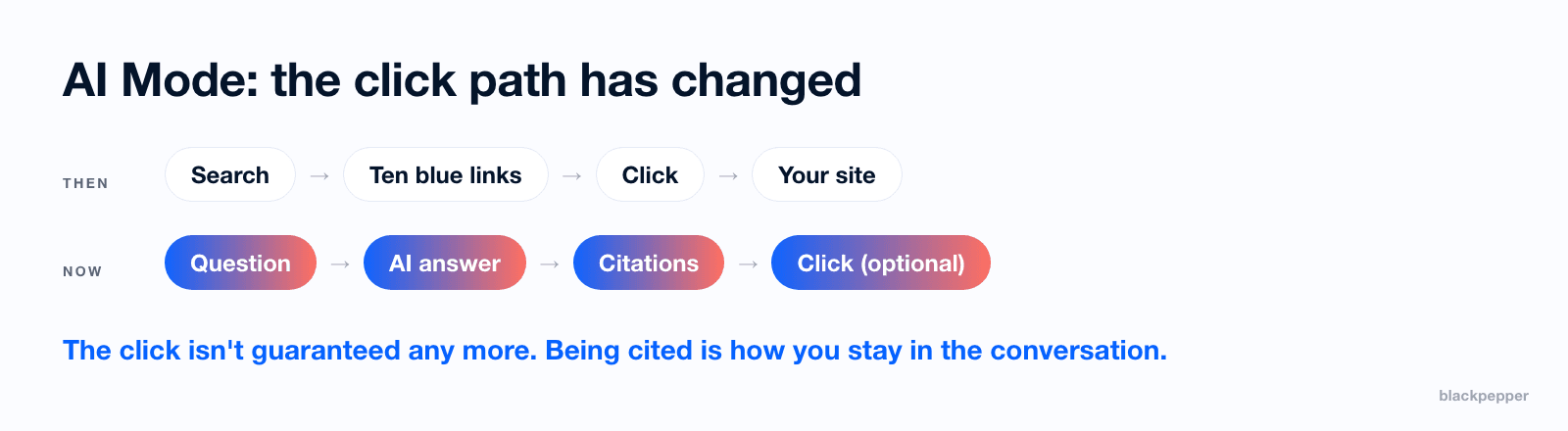
Picture the old search results page: ten blue links, a few ads, maybe a map. AI Mode throws that whole model out. It's Google's conversational search layer, and it works nothing like the search engine mechanics most SEO advice is still built around.
Here's the shift in plain terms: the user asks a question, and Google answers it completely, with citations, context, product comparisons and recommendations, all without the user ever needing to leave Google.
It's not the same thing as AI Overviews, which have been sitting above traditional results since mid-2024. AI Mode goes further than a summary bolted onto a normal search. It replaces the entire search session with something closer to a conversation.
And the data on what that does to clicks is stark.
The Numbers That Should Worry You
Let's not sugarcoat this one.
Early Semrush research on AI Mode found that only 6 to 8% of sessions led to a visit to an external website, which means roughly 93% ended without one. That comes from US desktop data in mid-2025, so treat it as an early indicator rather than today's exact rate. It's not a worst-case projection, though. It's measured behaviour.
Zoom out to all Google searches, including the ones happening outside AI Mode, and roughly two-thirds now end with zero clicks (about 65 to 68%, according to SparkToro's 2026 analysis). On mobile, that figure climbs to 77%. Ahrefs found that when an AI Overview appears on a standard search, the top organic result gets roughly 58% fewer clicks (Ahrefs, 2026, which notes this is a correlation rather than proven cause). For informational queries specifically, organic click-through drops as much as 61%.
Meanwhile, BrightEdge's tracking found AI Overviews on 48% of the queries it monitors (February 2026), though other trackers report lower figures. That's nearly half of the queries in its tracked set, answered before a single blue link ever loads.
A Pew Research study of 68,879 Google searches found that when an AI summary appeared, users clicked a traditional result just 8% of the time, compared to 15% without one. Nearly half the click-through, gone, on real users, independently measured.
These aren't edge cases stitched together to make a scary headline. This is the new baseline.
"But Google Says It's Still Sending Billions of Clicks"
They do say that. And technically, it's true.
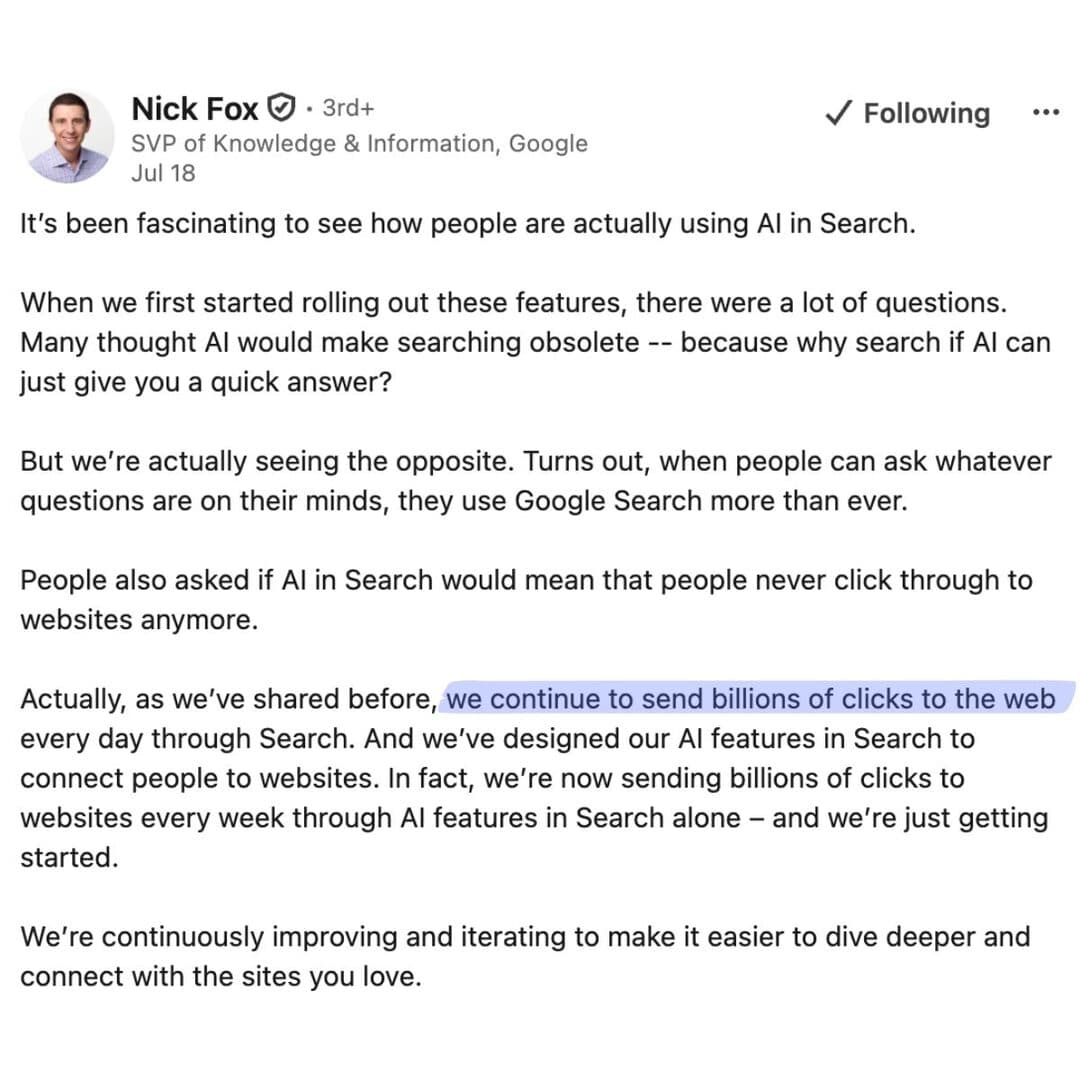
In July 2026, Google told the industry its AI search features still send "billions of clicks to websites each week." Google hasn't published the data behind that number. Reassuring, until you remember Google processes roughly 5.9 trillion searches per year. Billions of clicks against trillions of queries is a ratio that's shifted dramatically, even if the raw number sounds big on its own.
Google also says users who engage with AI Mode end up running more searches overall. That may well be true. But more searches with fewer clicks per search still adds up to less traffic landing on your site.
So the real question was never whether Google sends traffic. It's whether your share of it is growing or shrinking. For most businesses right now, it's shrinking.
The Blind Spot Hiding Inside Your Own Analytics
Here's what makes this genuinely hard to diagnose: your analytics might not even be showing you the full picture.
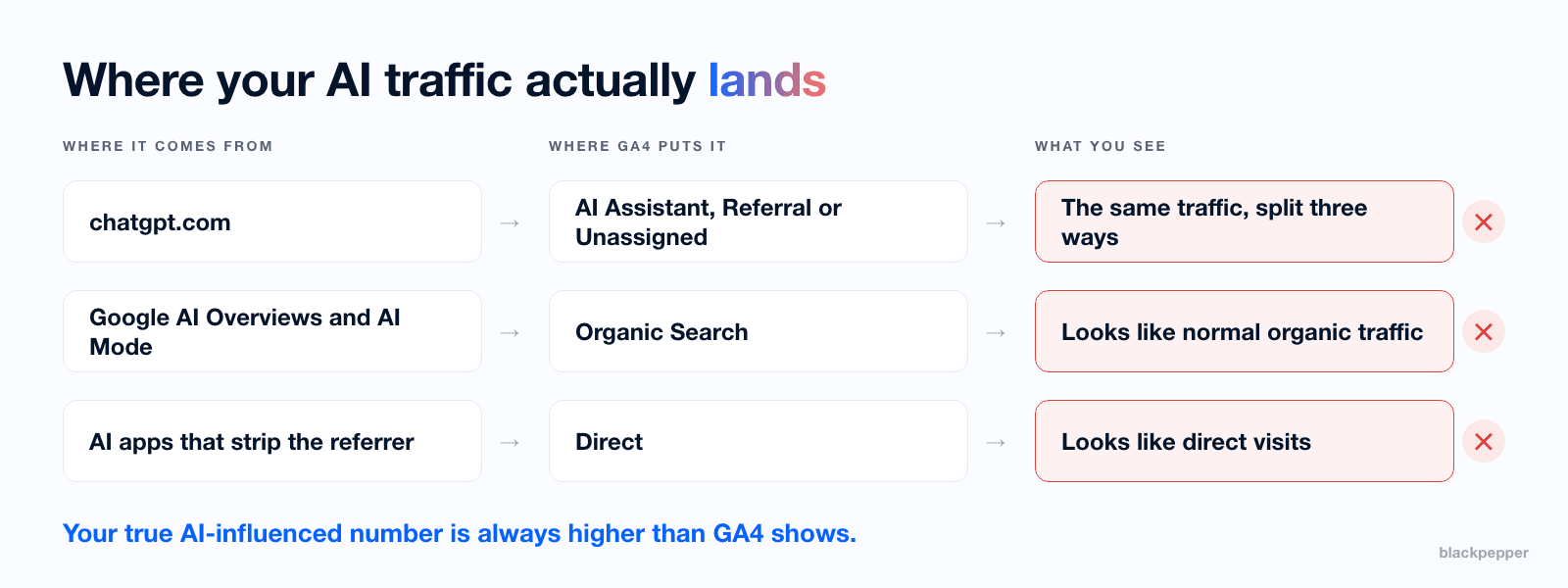
Google added a native AI Assistant channel to GA4 in May 2026, which sounds useful until you actually try to use it. A single source like chatgpt.com can split across three different channels in your reports: AI Assistant, Referral, and Unassigned. Same traffic, scattered across three separate buckets like mail sorted into the wrong boxes.
Here's the part that catches people out completely: traffic from Google's own AI Overviews and AI Mode doesn't land in the AI channel at all. It gets folded straight into ordinary Organic Search. So the single biggest AI surface affecting your traffic is invisible as "AI" in your own reporting.
Add in AI apps with in-app browsers that strip the referrer entirely, and those sessions dump into Direct too.
Put it together and you're almost certainly undercounting AI-influenced traffic while overcounting what's left of traditional organic. That's a dangerous blind spot when you're trying to work out what's actually happening to your numbers.
Search Stops Being a Single Moment
Click erosion is just the first wave. The structural change sitting underneath it is bigger still.
At Google I/O 2026, Google's head of Search, Liz Reid, described something she called "agentic search": a system where you ask Google a question, and if the answer doesn't exist yet, Google stores your query and circles back later, across every device you use, once the information becomes available, with no follow-up needed from you.
This isn't pure speculation. A Google patent called Autonomously Providing Search Results Post-Facto describes a very similar idea (the original was filed in 2017, with a continuation published in April 2026), and Reid described the direction as something coming soon. Google hasn't said the patent is the system she meant. Sundar Pichai has called task-based search "the future."
Think about what that means for a moment. Search stops being a one-shot transaction. It becomes persistent, an always-on agent quietly working on someone's behalf in the background.
For businesses, that changes the equation entirely. If a user asks for something and Google keeps watching until the answer exists, you need to be the answer whenever it eventually surfaces, whether that's the moment someone searches or weeks later, once your content finally clears the system's quality bar.
If You Sell Products, This Gets More Complicated
For retailers, the disruption runs deeper again.
Google's Universal Commerce Protocol (UCP), launched in January 2026, lets customers discover, compare and buy products inside AI Mode, without visiting your website. Google's Merchant Center help page says it's currently available to select merchants in the US, Canada and Australia, so it isn't open to every retailer yet, including those in New Zealand. It still shows where shopping is heading. Retailers stay the seller of record, but the shopper may never see your site.
For merchants who are eligible, the transaction can happen inside the conversation. The AI agent can handle discovery, comparison and checkout on the shopper's behalf.
Structured product data is what makes that possible. AI shopping agents rely on clear details like price, shipping and return information, and they can't recommend a product they can't read. Fields worth checking include:
priceValidUntilshippingDetails.deliveryTimehasMerchantReturnPolicy.merchantReturnDays
Check Google's Merchant Center documentation for current requirements. A page with missing or incomplete product data gives an AI agent less to work with, so a competitor with cleaner data may be recommended instead. It's a data infrastructure gap hiding behind what looks, on the surface, like a perfectly good product page.
Even Google Is Quietly Citing Itself
Here's another layer worth knowing about.
Data from Profound, an AI-visibility platform, shows that google.com is now the second most-cited domain in AI Mode. Its citation share grew 8.4x between April and June 2026, driven almost entirely by two surfaces: Google Business Profile cards and Product Knowledge Panels. This is Profound's tracking, and Google hasn't confirmed it.
What that means in practice: someone asks AI Mode a local question, it surfaces a Google Business Profile card as the answer, and the business behind it never gets the click. Someone asks about a product, and Google cites its own product panel instead.
Your information still gets surfaced. It just lives on Google's own property while it does it, and the click to your actual site becomes entirely optional.
What You Can Actually Do About It
So here's where we land. What can you actually do about all of this?
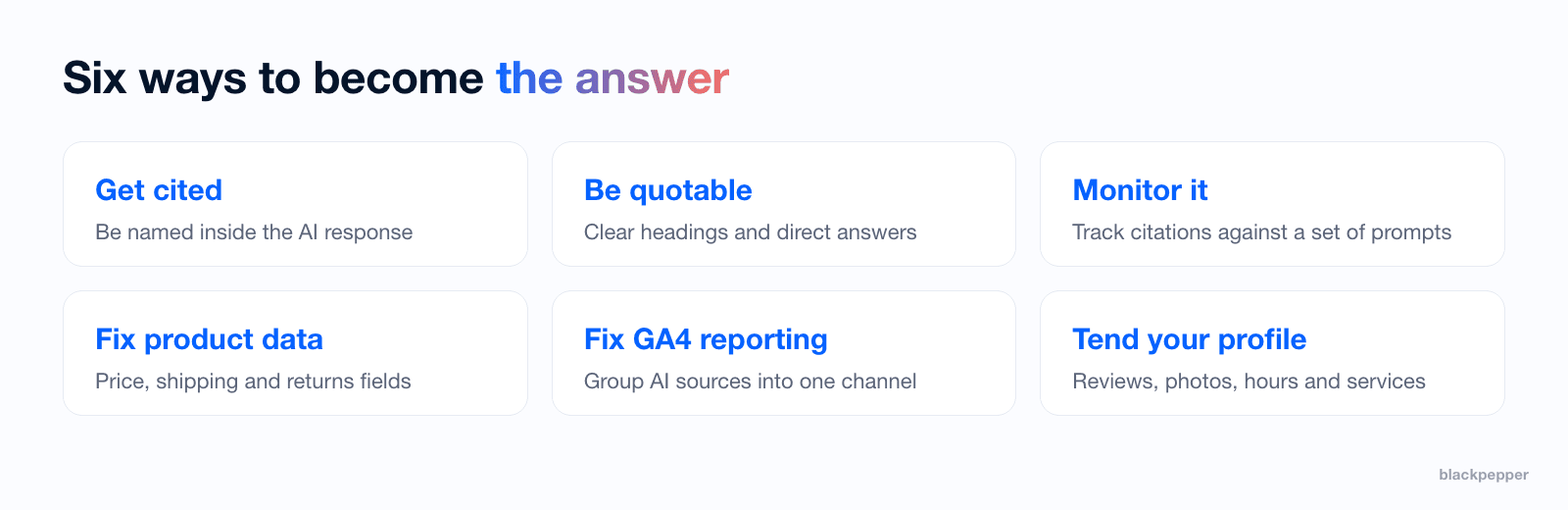
1. Accept That Visibility Now Beats Rankings
Sitting in position one means very little if an AI Overview parks above you and absorbs the click before anyone scrolls that far. The metric that matters now is whether you're cited inside the AI response itself.
Seer Interactive found that brands cited in AI Overviews saw 35% more organic clicks than those that weren't (3,119 informational queries, data to September 2025, and a correlation rather than proven cause). One 2026 benchmark of 312 B2B tech companies (Opollo) found AI-referred visitors converting at 14.2%, compared to 2.8% for Google organic. Other studies find smaller or larger gaps, from roughly 2x to over 20x depending on the industry, so treat it as a sign rather than a rule.
Less traffic overall, but often better traffic. That's the trade-off on the table.
2. Structure Your Content So It's Easy to Quote
AI engines pull answers from content that's clearly structured: definitive headings, direct answers to real questions, FAQ schema, clear relationships between entities.
Write content that answers a specific question concisely, then elaborates underneath it. If an AI can't extract a clean answer from your page in a few seconds, it'll happily find one that's easier to lift.
3. Monitor This Continuously
AI citations regenerate with every single query. A citation confirmed last month can vanish without warning this month. Spot-checking by manually prompting an LLM every now and then tells you nothing about the trend underneath it.
You need consistent monitoring against a defined set of prompts, tracking citations, share of voice and sentiment over time.
4. Fix the Data Plumbing Behind Your Products
If you're in ecommerce: audit your product schema and merchant feeds. Check whether your top products carry the key fields (price validity, shipping time and return window), and check Google's Merchant Center documentation for current requirements. Gaps there can make you harder for AI agents to recommend, however good the rest of your SEO looks.
How big the job is depends on your platform, and it's exactly the kind of gap a technical SEO audit is built to catch before it costs you sales.
5. Fix What Your Analytics Is Actually Telling You
Build a custom channel group in GA4 that matches AI sources by domain. Medium is the field quietly failing you here, so leave it out entirely. That collapses the fragmented reporting into one accurate number for identified AI traffic. Review it monthly.
And understand what it still can't show you: traffic from Google's own AI features stays buried in Organic Search, and AI app traffic with stripped referrers lands in Direct regardless. Your true AI-influenced number is always higher than whatever GA4 hands you.
6. Treat Your Google Business Profile Like It Matters
With google.com becoming AI Mode's second most-cited domain, largely through Business Profile cards, a well-maintained GBP is now a direct input into AI-generated answers. Fresh reviews, recent photos, accurate hours and complete service descriptions have quietly become what AI needs to confidently recommend you, well beyond their old job as local SEO basics.
The Shift Isn't Coming. It Already Happened.
The biggest risk right now isn't that AI Mode will eventually disrupt your traffic somewhere down the line. It's that it already has, and you've been measuring the decline with tools that can't show you the cause.
Organic search is far from dead. It's being restructured around AI-generated answers, and the businesses that adapt, by structuring content for citation, fixing their data infrastructure and measuring what actually matters, will capture a disproportionate share of what's left.
The ones that don't will keep watching their traffic slide and wondering why their SEO "isn't working anymore."
It is working. The game just changed underneath it.
At Blackpepper, we help ecommerce and service businesses navigate exactly this shift: adapting SEO strategy for AI-driven search, fixing the data infrastructure that determines whether you're visible or invisible, and measuring what actually matters in 2026. If your traffic's been sliding and you're not sure why, get in touch.
FAQs
Why has my organic traffic dropped in 2026 with no penalty or algorithm update?
Most likely cause is Google's AI Mode. Early Semrush research found that roughly 93% of AI Mode sessions ended without a click to an external site, and BrightEdge's tracking found AI Overviews on 48% of the queries it monitors. Both cut into the click share available to traditional organic results even when your rankings haven't moved at all.
What is the difference between AI Mode and AI Overviews?
AI Overviews are a summary that appears above traditional search results. AI Mode replaces the search results page entirely with a full conversational answer, including citations, comparisons and recommendations, without requiring the user to leave Google.
Does AI Mode affect ecommerce sites differently?
Yes - both for traditional Search, and in the sense of Liz Reid's "agentic commerce". Google's Universal Commerce Protocol (UCP) lets shoppers discover, compare and buy products inside AI Mode itself. It's currently available to select merchants in the US, Canada and Australia. Product pages with incomplete product data, such as missing price validity, shipping time or return policy fields (priceValidUntil, shippingDetails.deliveryTime, hasMerchantReturnPolicy.merchantReturnDays), give AI agents less to work with, so check Google's Merchant Center documentation for current requirements.
How do I see how much of my traffic is coming from AI sources?
GA4's native AI Assistant channel undercounts AI traffic because Google's own AI Overviews and AI Mode traffic get folded into standard Organic Search, and in-app browser traffic often loses its referrer and lands in Direct. Building a custom channel group that matches AI domains directly gives a far more accurate picture than GA4's default medium-based grouping.
Is organic search dead because of AI Mode?
No. Organic search is being restructured around AI-generated answers, and it's still very much alive. Brands cited inside AI Overviews saw 35% more organic clicks in one Seer Interactive study, and one 2026 B2B benchmark found AI-referred traffic converting at roughly five times the rate of Google organic, so the opportunity has shifted toward earning citations as well as rankings.